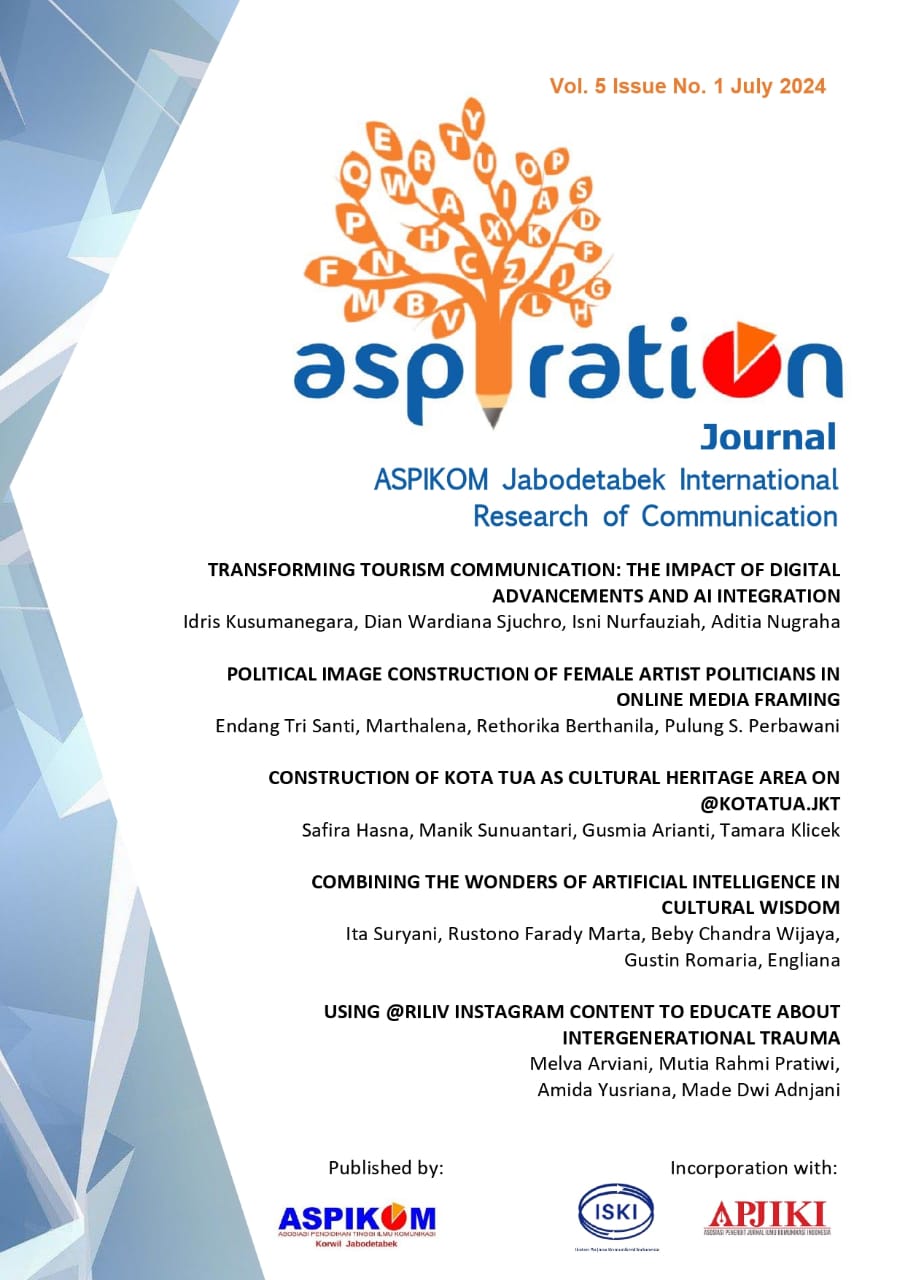
TRANSFORMING TOURISM COMMUNICATION: THE IMPACT OF DIGITAL ADVANCEMENTS AND AI INTEGRATION
DOI:
https://doi.org/10.56353/aspiration.v5i1.54Keywords:
Tourism Communication, Digital Advancements, AI IntegrationAbstract
This research explores the dynamic interplay between tourism and communication, with a specific focus on the influence of digital advancements, including AI-powered tools, on tourism communication within a descriptive qualitative approach and literature study framework. Research Issues: The primary research issue addressed in this study pertains to the impact of digital advancements and AI integration in descriptive qualitative approach and literature study-based tourism communication. Communication Philosophy: A dialogical communication philosophy is adopted, emphasizing meaningful engagement between tourism providers and travelers. Communication Paradigm: The study aligns with a constructivist communication paradigm, recognizing the co-creation of meaning in tourism communication. This research underscores the significance of collaborative efforts among government agencies, travel industry stakeholders, travelers, and academics to fully utilize AI's potential in enhancing qualitative tourism communication. The study's findings are anticipated to benefit all stakeholders in tourism communication by improving efficiency and personalization, ultimately contributing to the industry's growth and sustainability.
References
Alotaibi, R., Ali, A., Alharthi, H., & Almehamadi, R. (2020). AI Chatbot for Tourism Recommendations A Case Study in the City of Jeddah, Saudi Arabia. International Journal of Interactive Mobile Technologies, 14(19). https://doi.org/10.3991/ijim.v14i19.17201
Androutsopoulou, A., Karacapilidis, N., Loukis, E., & Charalabidis, Y. (2019). Transforming the communication between citizens and government through AI-guided chatbots. Government Information Quarterly, 36(2). https://doi.org/10.1016/j.giq.2018.10.001
Arcos-Pumarola, J., Almela, M. S., & Maestre, B. R. (2022). VOLUNTEER TOURISM: REFLECTIONS FROM APPLIED ETHICS. Tourism, Culture and Communication, 22(3). https://doi.org/10.3727/109830421X16345418234047
Biendicho, M., Papaoikonomou, E., & Setó-Pamies, D. (2022). TOURISTS GO HOME! EXAMINING ANTITOURISM IN BARCELONA FROM AN EMOTIONS PERSPECTIVE. Tourism, Culture and Communication, 22(3). https://doi.org/10.3727/109830421X16345418234010
Chen, F., & Terken, J. (2023). User Experience. In Springer Tracts in Mechanical Engineering. https://doi.org/10.1007/978-981-19-3448-3_6
Gupta, S., Modgil, S., Lee, C. K., & Sivarajah, U. (2023). The future is yesterday: Use of AI-driven facial recognition to enhance value in the travel and tourism industry. Information Systems Frontiers, 25(3). https://doi.org/10.1007/s10796-022-10271-8
Hollinshead, K., Suleman, R., & Nair, B. B. (2021). The Unsettlement of Tourism Studies: Positive Decolonization, Deep Listening, and Dethinking Today. Tourism Culture & Communication, 21(2). https://doi.org/10.3727/109830421x16191799472033
Isaac, R. K., & Platenkamp, V. (2019). A future perspective on tourism and cultural dynamics. Tourism, Culture and Communication, 19(4). https://doi.org/10.3727/194341419X15542140077549
Kim, M. J., Lee, C. K., & Contractor, N. S. (2019). Seniors’ usage of mobile social network sites: Applying theories of innovation diffusion and uses and gratifications. Computers in Human Behavior, 90. https://doi.org/10.1016/j.chb.2018.08.046
Kotler, P., & Keller, K. L. (2009). Marketing management (13th ed.). In Prentice Hall.
Krishnan, C., Gupta, A., Gupta, A., & Singh, G. (2022). Impact of Artificial Intelligence-Based Chatbots on Customer Engagement and Business Growth. In Studies in Big Data (Vol. 113). https://doi.org/10.1007/978-3-031-10869-3_11
Lachance, J. (2022). THE EXPERIENCE OF DISCONNECTING FROM INFORMATION AND COMMUNICATION TECHNOLOGY (ICT) WHILE TRAVELING IN LATE MODERNITY. Tourism, Culture and Communication, 22(1). https://doi.org/10.3727/109830421X16262461231792
Lee, Y. (2022). How dialogic internal communication fosters employees’ safety behavior during the COVID-19 pandemic. Public Relations Review, 48(1), 102156. https://doi.org/10.1016/j.pubrev.2022.102156
Lin, C. A. (1996). Standpoint: Looking back: The contribution of Blumler and Katz’s uses of mass communication to communication research . Journal of Broadcasting & Electronic Media, 40(4). https://doi.org/10.1080/08838159609364379
Menzli, L. J., Smirani, L. K., Boulahia, J. A., & Hadjouni, M. (2022). Investigation of open educational resources adoption in higher education using Rogers’ diffusion of innovation theory. Heliyon, 8(7). https://doi.org/10.1016/j.heliyon.2022.e09885
Munar, A. M., & EK, R. (2022). DIGITAL TOURISM COMMUNICATION AND DEMOCRACY. Tourism, Culture and Communication, 27(2). https://doi.org/10.3727/109830421X16296375579589
Orden-Mejía, M., & Huertas, A. (2022). Analysis of the attributes of smart tourism technologies in destination chatbots that influence tourist satisfaction. Current Issues in Tourism, 25(17). https://doi.org/10.1080/13683500.2021.1997942
Palos-Sanchez, P., Saura, J. R., Velicia-Martin, F., & Cepeda-Carrion, G. (2021). A business model adoption based on tourism innovation: Applying a gratification theory to mobile applications. European Research on Management and Business Economics, 27(2). https://doi.org/10.1016/j.iedeen.2021.100149
Pencarelli, T. (2020). The digital revolution in the travel and tourism industry. Information Technology and Tourism, 22(3). https://doi.org/10.1007/s40558-019-00160-3
Samara, D., Magnisalis, I., & Peristeras, V. (2020). Artificial intelligence and big data in tourism: a systematic literature review. In Journal of Hospitality and Tourism Technology (Vol. 11, Issue 2). https://doi.org/10.1108/JHTT-12-2018-0118
Sulaeman, S. (2021). Factors determining behavioral intentions to use Islamic crowdfunding platform in times of Covid-19 in Indonesia: Evidence from TAM approach. Jurnal Ekonomi & Keuangan Islam, 7(1). https://doi.org/10.20885/jeki.vol7.iss1.art3
Downloads
Published
How to Cite
Issue
Section
License
Copyright (c) 2024 ASPIRATION Journal

This work is licensed under a Creative Commons Attribution-ShareAlike 4.0 International License.