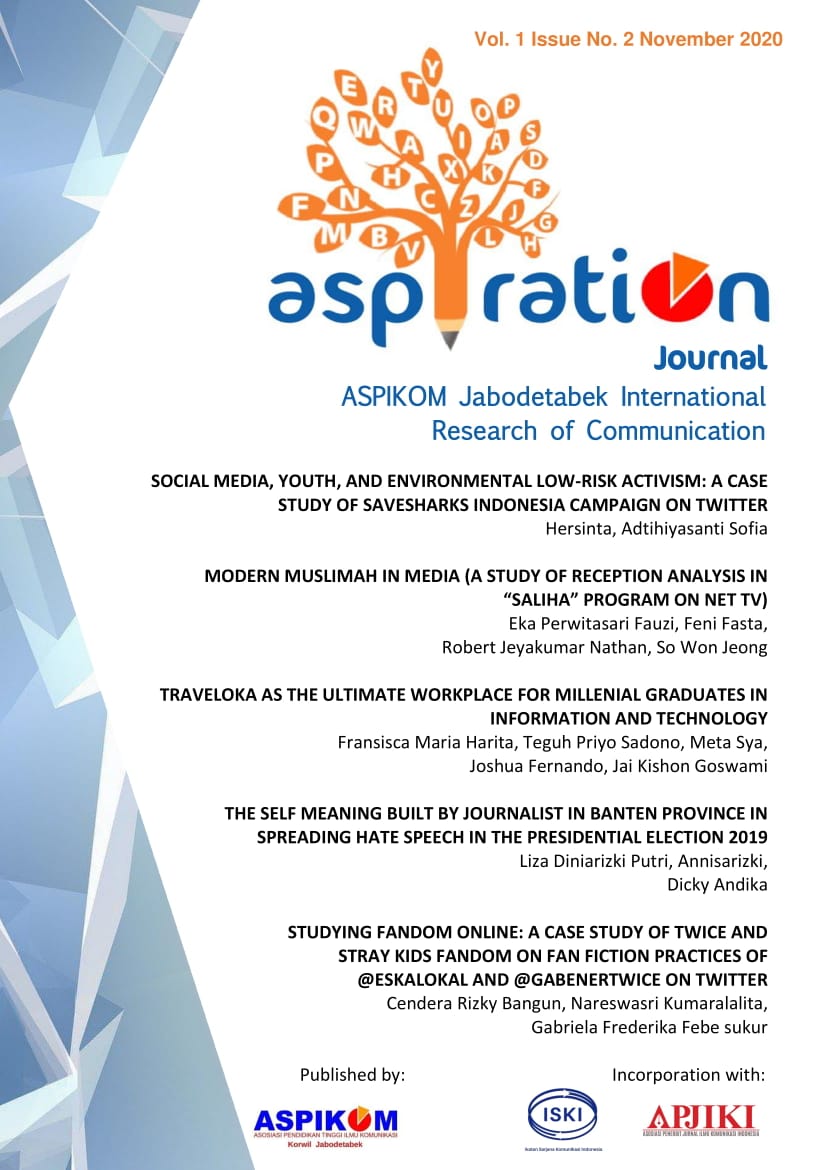
STUDYING FANDOM ONLINE: A CASE STUDY OF TWICE AND STRAY KIDS FANDOM ON FAN FICTION PRACTICES OF @ESKALOKAL AND @GABENERTWICE ON TWITTER
DOI:
https://doi.org/10.56353/aspiration.v1i2.18Keywords:
fan fiction, fandom, popular culture, social media, alternative universe, K-Pop, Stray Kids, TwiceAbstract
Popular culture is developing over time and fanfiction is product of popular culture. Fanfiction is a work of fiction created by fans as a sense of involvement (a culture of participation) between them and their idols. In addition to creating a sense of "closeness" with his idol, fan fiction can also provide a feeling of satisfaction for fans who want an ending or even a whole new world for their idols. Which later became one of the genres in Fan Fiction and was called the Alternative Universe. Fan fiction usually has a fairly long format, with platforms like Wattpad or Asian FanFic on the site, now the trend is changing to social media platforms, especially Twitter. Using @eskalokal and @gabenertwice as research objects, the method in this research is a qualitative method. Informants for this research are writers and readers of @eskalokal and @gabenertwice. After data collected, the next step is categorizing the interview transcript based on the informant's own words or in vivo coding. The result of this research is that the changing platform of fan fiction is more suitable for the informants. It turns out that many fans who initially liked fan fiction using Wattpad or website switch to the social media alternative universe because their attention span has decreased.
References
Bangun, C. R. (2019). Participatory Culture: A Study On Bangtan Boys Fandom Indonesia. KOMUNIKA: Jurnal Dakwah Dan Komunikasi. https://doi.org/10.24090/komunika.v13i2.2539
Baxter, Leslie A. & Babbie, E. (2018). The Basic of Communication Research. In Journal of Chemical Information and Modeling. https://doi.org/10.1017/CBO9781107415324.004
Burt, S. (2017). The Promise and Potential of Fan Fiction. Newyorker. https://www.newyorker.com/books/page-turner/the-promise-and-potential-of-fan-fiction
Duffet, M. (2013). Understanding fandom: An introduction to the study of media fan culture. Bloomsbury Publishing USA.
Gomes, S. L. R., & Barros, A. R. (2008). Convergence Culture: where old and new media collide; de Henry Jenkins. RECIIS. https://doi.org/10.3395/reciis.v2i1.165pt
Gray, J., Sandvoss, C., & Harrington, C. L. (2007). Fandom: Identities and communities in a mediated world. In Fandom: Identities and Communities in a Mediated World. https://doi.org/10.1177/009430610803700621
Handayani, P. (2019, April 25). Korean Wave in ASEAN keeps going strong. https://www.thejakartapost.com/news/2019/04/25/Korean-wave-in-asean-keeps-going-strong.html
Jenkins, H. (1992). Textual Poachers: Television Fans and Participatory Culture (Studies in Culture and Communication). In Les cultes médiatiques. https://doi.org/10.4000/books.pur.24185
Jenkins, H. (2006). Fans, bloggers, and gamers: Exploring participatory culture. In Fans, Bloggers, and Gamers: Exploring Participatory Culture. https://doi.org/10.1080/09548963.2014.1000599
McQuail, D., Blumler, J. G., & Brown, J. R. (1972). The television audience: A revised perspective. In Sociology of mass communications.
Romano, A. (2018, February 26). How K-pop became a global phenomenon. https://www.vox.com/culture/2018/2/16/16915672/what-is-kpop-history-explained
Seale, C. (2012). Generalizing from Qualitative Research. In The Quality of Qualitative Research. https://doi.org/10.4135/9780857020093.n8
Storey, J. (2012). Cultural Theory and Popular Culture. In Cultural Theory and Popular Culture. https://doi.org/10.4324/9781315832968
Thomas, A. (2006). Fan fiction online: Engagement, critical response and affective play through writing. Australian Journal of Language & Literacy, 29(3).
Vincent, B. (, October). A Brief History of K-pop. https://www.teenvogue.com/story/brief-history-of-k-pop
Downloads
Published
How to Cite
Issue
Section
License
Copyright (c) 2020 ASPIRATION Journal

This work is licensed under a Creative Commons Attribution-ShareAlike 4.0 International License.