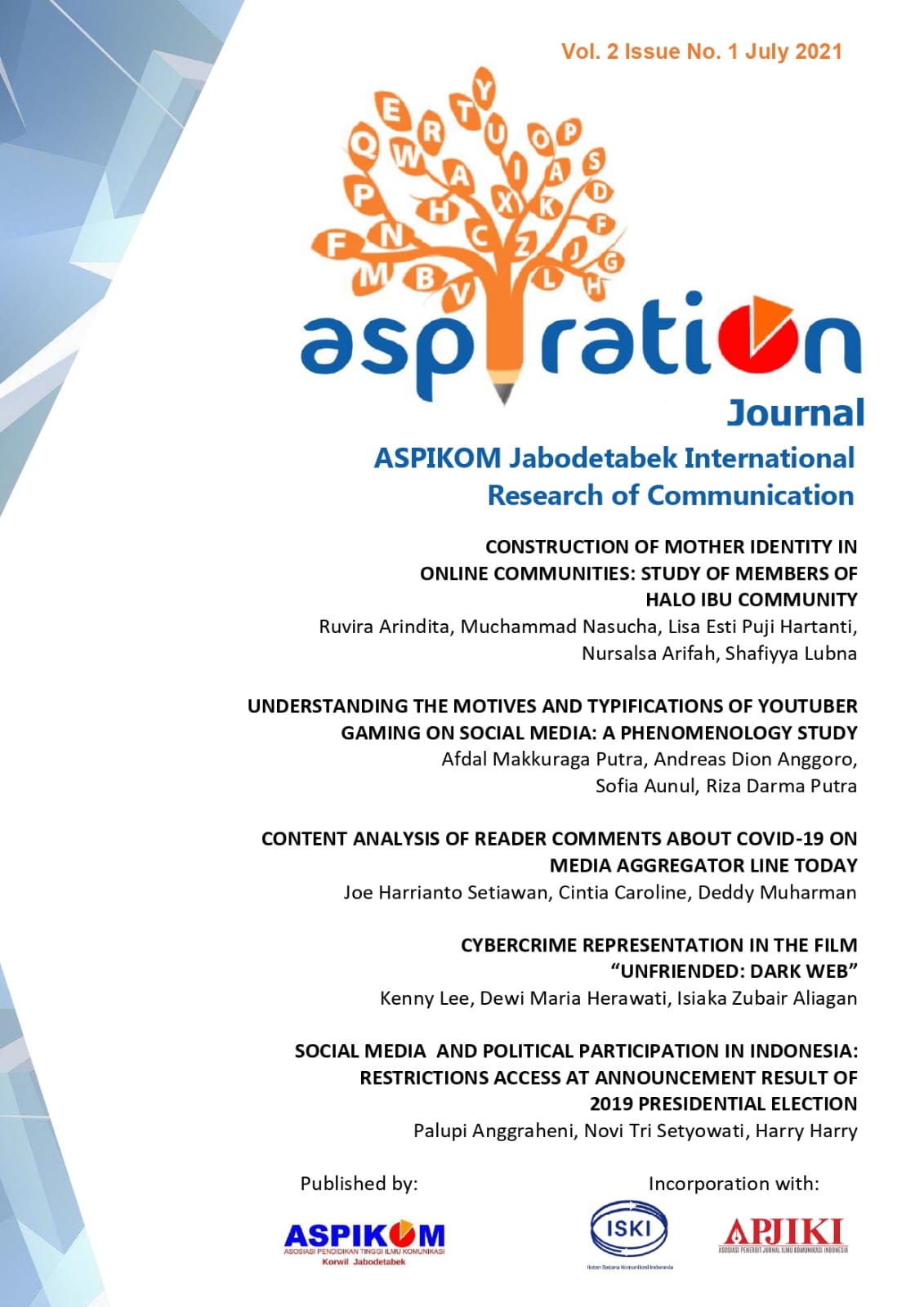
SOCIAL MEDIA AND POLITICAL PARTICIPATION IN INDONESIA: RESTRICTIONS ACCESS AT ANNOUNCEMENT RESULTS OF 2019 PRESIDENTIAL ELECTION
DOI:
https://doi.org/10.56353/aspiration.v2i1.23Keywords:
Dismediation, Political participation, Presidential election, Public opinion, Social mediaAbstract
The penetration of technology as a driving force for movement and a hub between humans and machines fundamentally shifts the way humans think, interact and move. One of the benchmarks for highly increasing digital activity in Indonesia nowadays is the massive use of the internet, including social media. On the other hand, the increasing use of social media also becomes a challenge in popularizing the political participation of the public. One example of a case that illustrates this phenomenon is the limitation of access to social media in the 2019 Presidential Election (Pilpres). The public experienced difficulties in accessing social media, after the announcement of the vote recapitulation of the 2019 Presidential Election. It can be seen as a challenge to the freedom of speech in Indonesia or the other hand could be seen as a preventive measure to prevent the escalation of riots. As library research, this paper discusses in more detail the relationship between the role of social media, and government policies, in the framework of political participation. The concept of social media’s role in political participation, especially in creating online public opinion by Robles-Moralez & Cordoba-Hernandez, is used to help analyze social media as a catalyst in increasing public engagement in elections. It can be concluded that social media plays a role as “dismediation” agent and disrupt power plays between conventional elite media in delivering information from government to citizen vice versa.
References
Ahmad, T., Alvi, A., & Ittefaq, M. (2019). The Use of Social Media on Political Participation Among University Students: An Analysis of Survey Results From Rural Pakistan. SAGE Open, 9(3), 215824401986448. https://doi.org/10.1177/2158244019864484
Anggraini, S., Afrizal, A., & Indradin, I. (2019). Regulasi Konflik Pemilu (Studi Kasus Resolusi Konflik Pilkada 2015 dan Persiapan Pemilu 2019 di Kabupaten Sijunjung). Jurnal Antropologi: Isu-Isu Sosial Budaya, 21(2), 177. https://doi.org/10.25077/jantro.v21.n2.p177-184.2019
APJII. (2019). Penetrasi Internet Indonesia 2018. Asosiasi Penyedia Jasa Internet Indonesia. https://apjii.or.id/downfile/file/BULETINAPJIIEDISI40Mei2019.pdf
Ardha, B. (2015). Social Media Sebagai Media Kampanye Partai Politik 2014 di Indonesia. Jurnal Visi Komunikasi, 13(1), 105–120. https://doi.org/https://dx.doi.org/10.22441/jvk.v13i1.383
Asrarudin, Purwana, D., & Madhakomala, R. (2020). Do Transformational Leadership, Interpersonal Communication, and Career Development Have Direct and Indirect Effect on Diplomats’ Organizational Commitment at the Ministry of Foreign Affairs Republic of Indonesia in Jakarta? IJHCM (International Journal of Human Capital Management), 4(1), 59–73. https://doi.org/10.21009/ijhcm.04.01.05
Budiarjo, M. (2008). Dasar-Dasar Ilmu Politik. Gramedia Pustaka Utama.
CNBC. (2019). CNBC: Whatsapp Medsos Dibatasi Pemerintah Sampai 25 Mei 2019. CNBC Indonesia. https://www.cnbcindonesia.com/tech/20190522144725-37-74298/whatsapp-medsos-dibatasi-pemerintah-sampai-25-mei-2019
CNN. (2019a). CNN : Demo 22 Mei Pemerintah Batasi Fitur Media Sosial. CNN. https://www.cnnindonesia.com/teknologi/20190522142806-185-397401/demo-22-mei-pemerintah-batasi-fitur-media-sosial
CNN. (2019b). CNN: Pakar Jelaskan Kemunculan Tagar INAectionobserverSOS. CNN. https://www.cnnindonesia.com/teknologi/20190418153850-185-387664/pakar-jelaskan-kemunculan-tagar-inaelectionobserversos
DEA. (2019a). Drone Emprit Academy Open Data: SNA “Militan.” DEA. https://pers.droneemprit.id/militan/
DEA. (2019b). Drone Emprite Academy Open Data. DEA. https://www.slideshare.net/IsmailFahmi3/evaluasi-kekecewaan-atas-debat-pertama-pilpres-2019?fbclid=IwAR1B-G-At0DihyfbUtQVTZgWQnymyMOG3rgcwv0hxSx3DeVXnZOt8YWki-Y
Effing, R., van Hillegersberg, J., & Huibers, T. (2011). Social Media and Political Participation: Are Facebook, Twitter and YouTube Democratizing Our Political Systems? Springer, 25–35. https://doi.org/10.1007/978-3-642-23333-3_3
Fensi, F. (2019). Paradoxic Language “Cebong-Kampret” in Facebook as a Mirror of The Political Language of Indonesia. Bricolage : Jurnal Magister Ilmu Komunikasi. https://doi.org/10.30813/bricolage.v5i02.1887
Gandakusumah, B., & Marta, R. F. (2021). Visualisasi Elemen Pembentuk Consumer Brandscape Melalui Oposisi Biner Semiotika Pemasaran Xing Fu Tang (幸福堂) Dan Xi Bo Ba (喜悦). Jurnal Bahasa Rupa, 4(2), 167–176. https://doi.org/10.31598/bahasarupa.v4i2.808
Gayatri, G., Rusadi, U., Meiningsih, S., Mahmudah, D., Sari, D., Kautsarina, N., & Karman, N. (2016). Digital Citizenship Safety Among Children and Adolescents in Indonesia. Jurnal Penelitian Dan Pengembangan Komunikasi Dan Informatika, 6(1). https://jurnal.kominfo.go.id/index.php/jppki/article/view/579
Halim, U., & Jauhari, K. D. (2019). Pengaruh Terpaan Media Terhadap Partisipasi Politik Dalam Pilkada Dki Jakarta 2017. Jurnal ASPIKOM, 4(1), 45. https://doi.org/10.24329/aspikom.v4i1.385
Hasfi, N. (2019). Komunikasi Politik di Era Digital. Politika: Jurnal Ilmu Politik, 10(1), 93. https://doi.org/10.14710/politika.10.1.2019.93-111
Hong, X., & Duan, C. (2020). The Construction of Sichuan Image under Multimodal Visual Grammar—Taking the Documentary “Aerial China (Sichuan)” as an Example. Open Journal of Social Sciences, 08(12), 108–120. https://doi.org/10.4236/jss.2020.812010
Ilvarianto, D. S., & Legowo, N. (2017). Incident management implementation using continual service improvement method at PT AOP. Proceedings - 2017 International Conference on Applied Computer and Communication Technologies, ComCom 2017. https://doi.org/10.1109/COMCOM.2017.8167094
Juditha, C., & Darmawan, J. (2018). Penggunaan Media Digital dan Partisipasi Politik Generasi Milenial. Jurnal Penelitian Komunikasi Dan Opini Publik, 22(2), 94–109. https://scholar.google.com/scholar?hl=en&as_sdt=0%2C5&q=Penggunaan+Media+Digital+dan+Partisipasi+Politik+Generasi+Milenial&btnG=
Khakim, M. S., Nugraha, A. F., Sukanti, S., & Sarwedi, A. R. (2020). Kontribusi Mahasiswa Daerah Dalam Penanganan Intoleransi Melalui Sinergi Perguruan Tinggi Di Diy. Jurnal Pendidikan Kewarganegaraan, 10(1), 62. https://doi.org/10.20527/kewarganegaraan.v10i1.8361
Latukolan, J. J., Marta, R. F., & Engliana, E. (2021). When Words Matter: Language Choices and Brand Building on Two Global Coffee Shop Retail Brands in Indonesia. Budapest International Research and Critics Institute (BIRCI-Journal): Humanities and Social Sciences, 4(2), 2899–2906. https://doi.org/10.33258/birci.v4i2.1974
Lee, S. H. (2017). Digital democracy in Asia: The impact of the Asian internet on political participation. Journal of Information Technology & Politics, 14(1), 62–82. https://doi.org/10.1080/19331681.2016.1214095
Lumampauw, A., Marta, R. F., Nugroho, Y., Sandel, T. L., & Lie, S. (2021). The art of honing the conscience through bukalapak ads : barongsai Indonesia , juara hati membangun bangsa. International Journal of Visual and Performing Arts, 3(1), 9–21. https://doi.org/https://doi.org/10.31763/viperarts.v3i1.342
Magstadt, T. (2010). Understanding Politics, Ideas, Institution and Issues (9th Ed). Wadsworth Publishing Company.
Marta, R. F., Prasetya, A. A., Laurensia, B., Stevani, S., & Syarnubi, K. L. (2020). Imbalance Identity in E-Sports News Intersectionality on Covid-19 Pandemic Situation. Jurnal ASPIKOM, 5(2), 206. https://doi.org/10.24329/aspikom.v5i2.769
Marta, R. F., & Sierjames, J. (2018). Identifikasi Nilai Kemajemukan Indonesia sebagai Identitas Bangsa dalam Iklan Mixagrip Versi Keragaman Budaya Indonesian Pluralism Value Identification as Nation Identity in Mixagrip Advertising Version of Keragaman Budaya. Jurnal Kajian Komunikasi, 6(1), 37–50.
Mawalia, K. Al, & Sanityastuti, M. S. (2020). Komunikasi Antar Budaya Madura dan Yogyakarta (Studi Etnografi Adaptasi Speech Code Mahasiswa Madura pada Masyarakat Yogyakarta). Panangkaran: Jurnal Penelitian Agama Dan Masyarakat, 3(2), 169. https://doi.org/10.14421/panangkaran.2019.0302-02
Nafie, J. A. (2020). Pemaknaan Profesi Perempuan Dalam Video Musik Lokal Di Nusa Tenggara Timur. Jurnal Communio : Jurnal Jurusan Ilmu Komunikasi, 9(1), 1538–1563. https://doi.org/10.35508/jikom.v9i1.2311
Putra, R. A. (2019). Tantangan Media Massa Dalam Menghadapi Era Disrupsi Teknologi Informasi. JUSIFO, 5(1), 1–6. https://doi.org/10.19109/jusifo.v5i1.5003
Rahim, R., Armay, E. F., Susilo, D., Marta, R. F., & Alanda, A. (2019). Cloud computing security issues and possibilities. International Journal of Engineering and Advanced Technology, 8(6 Special Issue), 927–931. https://doi.org/10.35940/ijeat.F1175.0886S19
Robles-Morales, J., & Córdoba-Hernández, A. (2019). Digital Political Participation, Social Networks and Big Data. Springer Nature.
Safenet.or.id. (2019). Penjelasan tentang Pembatasan Internet: Apa, Siapa, dan Kenapa? South-East Asia Freedom of Expression Network. https://id.safenet.or.id/2019/10/penjelasan-tentang-pembatasan-internet-apa-siapa-dan-kenapa/
Salleh, S. M., Mohamad, E., Ahmad, A. L., Nazri, N. A., Muhd Shukri, F., & Abdullah, N. A. V. (2018). Iklan Tahun Baru Cina Petronas: Suatu Analisis Terhadap Pemaparan Identiti Budaya Kaum Cina (Chinese New Year Petronas Advertisment: An Analysis of The Portrayal of Chinese Cultural Identity). Jurnal Komunikasi, Malaysian Journal of Communication. https://doi.org/10.17576/jkmjc-2015-3102-32
Sari, N., Marta, R. F., Angreani, N., Harry, H., & Perkasa, M. I. A. (2021). Menakar Loyalitas Konsumen berdasarkan Persepsi Nilai dan Kepercayaan Merek Geprek Bensu. Soetomo Communication and Humanities, 2(2). https://ejournal.unitomo.ac.id/index.php/sch/article/view/4078
Sereenonchai, S., & Arunrat, N. (2021). Understanding Food Security Behaviors during the COVID-19 Pandemic in Thailand : A Review. Agronomy, 11(May 2020), 1–15.
Tang, P., Quan, K., & Zhu, J. (2020). The Construction of China’s Images through Multimodal Metaphor: A Case Study of China-related BBC Documentaries. Theory and Practice in Language Studies, 10(9), 1044. https://doi.org/10.17507/tpls.1009.05
Tinarbuko, S. (2019). Membaca Makna Iklan Politik Pilpres 2019. Mudra Jurnal Seni Budaya. https://doi.org/10.31091/mudra.v34i2.707
Vaccari, C., & Valeriani, A. (2018). Digital Political Talk and Political Participation: Comparing Established and Third Wave Democracies. SAGE Open, 8(2), 215824401878498. https://doi.org/10.1177/2158244018784986
Wardhani, P. S. N. (2018). Partisipasi Politik Pemilih Pemula dalam Pemilihan Umum. JUPIIS: Jurnal Pendidikan Ilmu-Ilmu Sosial, 10(1), 57–62. https://doi.org/https://doi.org/10.24114/jupiis.v10i1.8407.g9060
Winarno, S. (2019, September 28). Efek Echo Chamber Demonstrasi. Jawa Pos.
Yin, R. (2016). Qualitative Research from Start to Finish. Guilford Press.
Yusriyah, K., Fatoni, A., & Mansyur, M. A. (2020). Communication Networks Analysis on Information Dissemination of the Moving of Capital City From Jakarta to East Kalimantan. Aspiration Journal.
Downloads
Published
How to Cite
Issue
Section
License
Copyright (c) 2021 ASPIRATION Journal

This work is licensed under a Creative Commons Attribution-ShareAlike 4.0 International License.