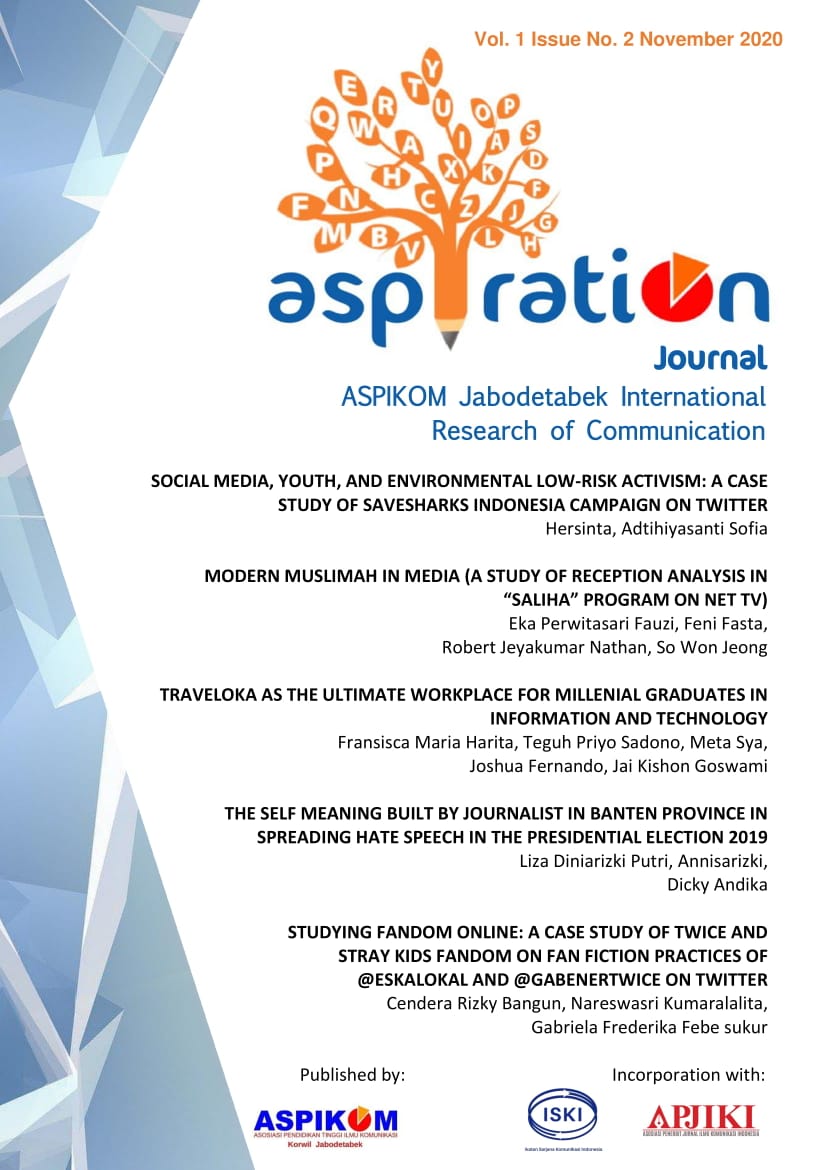
MODERN MUSLIMAH IN MEDIA: A STUDY OF RECEPTION ANALYSIS IN “SALIHA” PROGRAM ON NET TV
DOI:
https://doi.org/10.56353/aspiration.v1i2.19Keywords:
social construction, muslim women, reception analysis, television audienceAbstract
Indonesia, as a country with the largest Muslim population in the world, holds a significant market share of the Islamic industry, especially for Muslim women. This study discusses how media constructs meaning for modern Muslim women's identity, in "Saliha" a program aired on Indonesia national television, NET TV. This qualitative research is conducted based on social construction of reality theory and using Stuart Hall's reception analysis method. The data was obtained via in-depth interviews and Focus Group Discussion. Findings indicate shifting views of Muslim women portrayed in television; these findings add to the continuous mediatization of modern Muslims, especially women. Thus, the existence of Muslim women continued to negotiate and be redefined through images, narratives, and knowledge constructed in media for market consumption.
References
Ahmed, L. (2005). Muslim Women and Other Misunderstandings. Onbeing.Org. https://onbeing.org/programs/leila-ahmed-muslim-women-and-other-misunderstandings/
Alatas, A., & Desliyanti, F. (2001). Revolusi jilbab: kasus pelarangan jilbab di SMA negeri se-Jabotabek, 1982-1991. Al-I’tishom Cahaya Umat.
Ali, H. (2018). Relasi Agama dan Negara: Tiga Tipologi Muslim Indonesia. Hasanuddinali.Com. https://hasanuddinali.com/2018/09/24/relasi-agama-dan-negara-tiga-tipologi-muslim-indonesia/
Aminudin, A. (2018). Audience in reception analysis perspective. The Asian Conference on Media, Communication & Film 2018 Official Conference Proceedings.
Apriyanti, S. (2019). Analisis Produksi Program Saliha NET TV. UIN Syarif Hidayatullah.
Ardianto, E., & Komala, L. (2007). Komunikasi Massa: Suatu Pengantar. Bandung. Simbiosa Rekatama Media.
Arifin, Z. (2017). Evaluasi Pembelajaran: Prinsip Teknik Prosedur, Cetakan ke-10. Bandung. PT. Remaja Rosdakarya.
Aryani, K. (2006). Analisis Penerimaan Remaja terhadap Wacana Pornografi dalam Situs-Situs Seks di Media Online. Jurnal Masyarakat Kebudayaan Dan Politik. Tahun XIX. Nomor, 2.
Baksin, A. (2006). Jurnalistik Televisi: Teori dan Praktik. Bandung. Simbiosa Rekatama Media.
Baulch, E., & Pramiyanti, A. (2018). Hijabers on Instagram: Using Visual Social Media to Construct the Ideal Muslim Woman. Social Media and Society, 4(4). https://doi.org/10.1177/2056305118800308
Bjoernaas, T. I. (2015). Saving Muslim women: A feminist-postcolonial critique of veiling legislation in Norway. Islamophobia Studies Journal, 3(1), 78–89.
Bland, M., Theaker, A., & Wragg, D. W. (2005). Effective media relations: How to get results. London. Kogan Page Publishers.
Brunsdon, C., & Morley, D. (2005). The nationwide television studies. London. Routledge.
Castells, M. (2000). Materials for an exploratory theory of the network society1. The British Journal of Sociology, 51(1), 5–24.
Cherribi, S. (2006). From Baghdad to Paris: Al-Jazeera and the Veil. Harvard International Journal of Press/Politics, 11(2), 121–138. https://doi.org/10.1177/1081180X06286421
Fiske, J. (2001). Television Culture: Popular Pleasures and Politics (Studies in). London. Routledge.
Gökarıksel, B., & McLarney, E. (2010). Introduction Muslim Women, Consumer Capitalism, And The Islamic Culture Industry. Journal of Middle East Women’s Studies, 6(3), 1–18. https://doi.org/10.2979/mew.2010.6.3.1
Griffith, P., & Malik, A. (2018). Tackling Disengagement Among Pakistani And Bangladeshi Women In Britain. London. Institute for Public Policy and Research (IPPR).
Hadi, I. P. (2008). Penelitian khalayak dalam perspektif reception analysis. Scriptura, 2(1), 1–7.
Hall, S. (1980). Cultural studies: Two paradigms. Media, Culture & Society, 2(1), 57–72.
Hall, S. (1997). The work of representation. In Representation: Cultural representations and signifying practices (Vol. 2). London.
Haryanti, A., & Sari, S. D. S. R. (2018). Analysis Of Audience Reception On Youtube Towards Anti Cyberbullying Video Campaign In The Cyber Bully By Cameoproject. Social Economics and Ecology International Journal, 2(1).
Hassim, N. (2014). Hijab and the Malay-Muslim Woman in Media. Procedia - Social and Behavioral Sciences, 155(October), 428–433. https://doi.org/10.1016/j.sbspro.2014.10.317
Independent.co.uk. (2019). What Is Modest Fashion And Why Is It Becoming Mainstream? Independent.Co.Uk. https://www.independent.co.uk/life-style/fashion/modest-fashion-asos-hijab-range-design-islam-religion-a8875636.html
Jensen, K. B. (1988). News as social resource: A qualitative empirical study of the reception of Danish television news. European Journal of Communication, 3(3), 275–301.
Jensen, K. B., & Rosengren, K. E. (1990). Five traditions in search of the audience. European Journal of Communication, 5(2), 207–238.
Kumbara, A. A. N. A. (2018). Genealogi teori dan metodologi di cultural studies. An1mage Journal Studi Kultural, III(1), 35–46. https://journals.an1mage.net/index.php/ajsk/article/view/56
Kusumawardani, V., Santoso, N. R., & Herawati, D. M. (2020). Youtube as a Media Expression of Transgender Women. ASPIRATION Journal, 1(1), 95–112.
Lang, G. E., & Lang, K. (1991). Watergate: An exploration of the agenda-building process. Agenda Setting. Readings on Media, Public Opinion and Policymaking, 277–289.
Luzar, L. C., & Monica, M. (2014). Penerapan cultural studies dan aliran filsafat dalam Desain Komunikasi Visual. Humaniora, 5(2), 1295–1304.
Makarim, N. H., Dimyati, D., & Kurniullah, A. Z. (2020). The Use Of Instagram Account In Constructing The Concept Of Beauty: A Case On “Unpad Geulis. ASPIRATION Journal, 1(1), 73–98.
McCombs, M. E., & Shaw, D. L. (1972). The Agenda-Setting Function of Mass Media. Public Opinion Quarterly, 36(2), 176–187.
McQuail, D. (2010). McQuail’s mass communication theory. London. Sage publications.
Morissan. (2016). The influence of regulator on television content in post-authoritarian Indonesia. International Journal of Humanities and Social Science Research, 2(11), 229–243. https://doi.org/10.17576/JKMJC-2019-3504-14
Morissan, A. C. W., & Hamid, F. (2010). Teori komunikasi massa. Bogor: Ghalia Indonesia.
Morley, D. (1993). Active audience theory: pendulums and pitfalls. Journal of Communication, 43(4), 13–19.
Mulyana, A. (2014). Representasi Gaya Hidup Pria Metrosexual Di Majalah Pria Ibukota. Jurnal Visi Komunikasi, 13(1), 69–86.
Narottama, D. (2008). Analisis Resepsi Terhadap Tayangan Republik Mimpi [FISIP Universitas Diponegoro]. http://eprints.undip.ac.id/19557/1/Analisis_Resepsi_Republik_Mimpi.pdf
Oubaha, D., & Amzaourou, O. (2017). Audience Reception analysis of publis service: Television News in Morocco. International Journal of Advanced Research (IJAR), 5(11), 457–469. https://doi.org/http://dx.doi.org/10.21474/IJAR01/5791
Rahmawati, A., Febriyanti, M., & Nurrachmi, S. (2012). Cultural Studies: Analisis Kuasa Atas Kebudayaan. Jurnal Ilmu Komunikasi, 2(2).
Reuters, T. (2018). State of the Global Islamic Economy Report 2018/2019.
Schäffner, C., & Bassnett, S. (2010). Politics, media and translation: Exploring synergies. In Political discourse, media and translation (pp. 1–29). Newcastle upon Tyne, Cambridge Scholars Publishing.
Severin, W. J., & Tankard, J. W. (1997). Communication theories: Origins, methods, and uses in the mass media. Longman New York.
Slama, M., & Barendregt, B. (2018). Introduction: Online publics in Muslim Southeast Asia: In between religious politics and popular pious practices. Asiascape: Digital Asia, 5(1–2), 3–31.
Storey, J. (2010). Cultural studies and the study of popular culture. Edinburgh. Edinburgh University Press.
Street, J. (2001). Mass media, politics and democracy. New York. Palgrave.
Subroto, D. S. (1994). Produksi Acara Televisi. Yogyakarta. Duta Wacana University Press.
Sullivan, C. (2020). Years of Dressing Dangerously: Modern Women, National Identity and Moral Crisis in Sukarno’s Indonesia, 1945-1966. Michigan. [University of Michigan]. https://deepblue.lib.umich.edu/handle/2027.42/163162
Thornham, S., Bassett, C., & Marris, P. (2009). Media studies: a reader. NYU Press.
Toni, A., & Fajariko, D. (2018). Studi Resepsi Mahasiswa Broadcasting Universitas Mercu Buana Pada Film Journalism “Kill The Messenger.” Jurnal Komunikasi, 9(2), 151. https://doi.org/10.24912/jk.v9i2.161
Warren, S. (2018). Placing faith in creative labour: Muslim women and digital media work in Britain. Geoforum, 97(September), 1–9. https://doi.org/10.1016/j.geoforum.2018.10.003
Warren, S. (2019). #YourAverageMuslim: Ruptural geopolitics of British Muslim women’s media and fashion. Political Geography, 69(May 2018), 118–127. https://doi.org/10.1016/j.polgeo.2018.12.009
Yulikhah, S. (2017). Jilbab antara kesalehan dan fenomena sosial. Jurnal Ilmu Dakwah, 36(1), 96–117.
Downloads
Published
How to Cite
Issue
Section
License
Copyright (c) 2020 ASPIRATION Journal

This work is licensed under a Creative Commons Attribution-ShareAlike 4.0 International License.