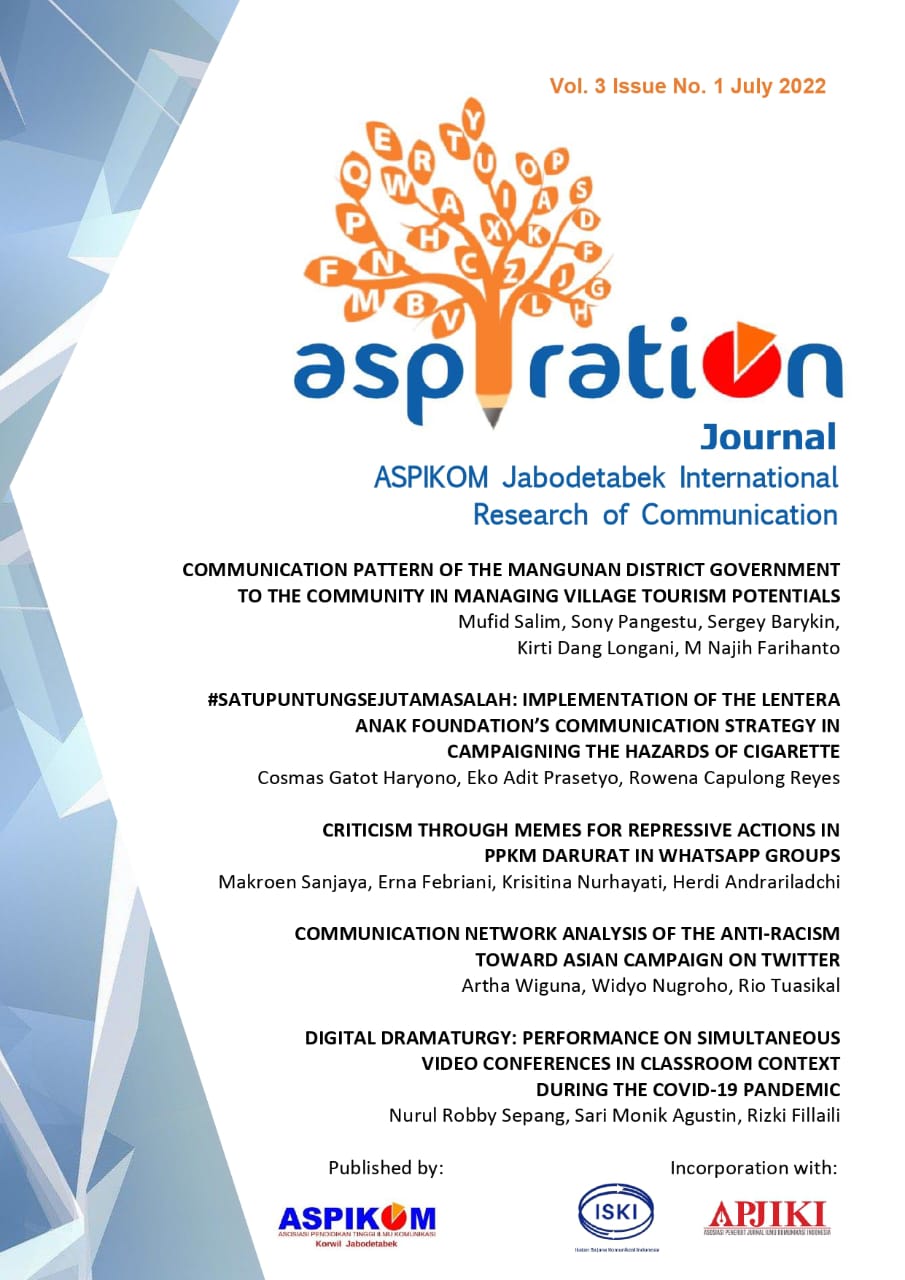
CRITICISM THROUGH MEMES FOR REPRESSIVE ACTIONS IN PPKM DARURAT IN WHATSAPP GROUPS
DOI:
https://doi.org/10.56353/aspiration.v3i1.38Keywords:
Critism, Memes, Repressive Action, Whatsapp GroupAbstract
In the current era of new media, social criticism as a form of freedom of expression and speech is easier to facilitate. New media such as Whatsapp groups, provide various features, which allow criticism in the form of memes, to be produced, distributed and consumed by virtual communities who are members of Whatsapp groups. This article examines how criticisms of the government's repressive actions in the policy of Imposing Community Activity Restrictions (PPKM) Emergency/Level 4 and 3 Java-Bali through memes circulated in the new media platform Whatsapp group, why criticisms expressed through memes were carried out through the Whatsapp group, and what else types of memes as a form of social criticism circulating in Whatsapp groups. Pen ResultseThis research shows that the PPKM Emergency/Level 4 and 3 Java-Bali policies are repressive in nature, drawing a lot of criticism in the Whatsapp group in the form of memes. Memes, which literally mean ideas that spread quickly from person to person, are even more certain thanks to the new Whatsapp media which is interactive, has a diffuse (not centralized) character, avoids state control, and is democratic. State actors who are in charge of PPKM are generally the target of social criticism through memes in Whatsapp groups.
References
Althusser, 2010. (n.d.). Retrieved June 2, 2022, from http://library.fis.uny.ac.id/opac/index.php?p=show_detail&id=1176
Armando, 2016. (n.d.). Retrieved June 3, 2022, from https://scholar.ui.ac.id/en/publications/televisi-indonesia-di-bawah-kapitalisme-global-2
Castells, Manuel. (2009). Communication Power. Oxford University Press
Christin, M., & Rahayu, L. (2017). Kritik Sosial Pada Media Sosial (Analisis Semiotika Pada Youtube “TV, Jasamu Tiada…”). J-IKA, 4(1), 36–46. https://doi.org/10.31294/KOM.V4I1.1789
CNN Indonesia. (n.d.). Retrieved June 2, 2022, from https://www.cnnindonesia.com/
CNN Indonesia - YouTube. (n.d.). Retrieved June 3, 2022, from https://www.youtube.com/c/CNNindonesiaOfficial
Covid19.go.id. (n.d.). Retrieved June 2, 2022, from https://covid19.go.id/
Creswell, 2015. (n.d.). Retrieved June 2, 2022, from https://www.ucg.ac.me/skladiste/blog_609332/objava_105202/fajlovi/Creswell.pdf
Dawkins, Richard. (1989). The Selfish Gene. Oxford University Press.
Dijck, Jose van & Phoell, Thomas Poell. (2013). Understanding Social Media Logic.
Media and Communication. Volume 1 Issue 1 Pages 2-14.
Google. (n.d.). Retrieved June 2, 2022, from https://www.google.com/
Guba, 1990. (n.d.). Retrieved June 2, 2022, from http://www.appstate.edu/~jacksonay/rcoe/guba.pdf
Habermas, Jürgen. (2006). Ratio and Rationalization of Society. Communicative Action Theory. Book One---Trans. Bantul: Discourse Creation.
Handayani, Fitrie, et al. (2016). The Use of Meme as a Representation of Public Opinion in Social Media: Case Study of Meme About Bekasi in Path and Twitter. HUMANIORS Vol. 7 No. July 3, 2016: 333-339.
Hobbs, Renee & Grafe, Silke. (2015). YouTube Pranking Across Culture.
Holmes, D. (2005). Communication theory: Media, technology, society. Communication Theory: Media, Technology, Society, 1–256. https://doi.org/10.4135/9781446220733
https://megapolitan.kompas.com/. (n.d.). Retrieved June 2, 2022, from https://megapolitan.kompas.com/
https://www.liputan6.com. (n.d.). Retrieved June 3, 2022, from https://www.liputan6.com/
Katadata.co.id. (n.d.). Retrieved June 2, 2022, from https://katadata.co.id/
Kiousis, Spiro. (2002). Interactivity: A Concept Explication. https://www.researchgate.net/publication.
KOMPASTV - YouTube. (n.d.). Retrieved June 3, 2022, from https://www.youtube.com/channel/UC5BMIWZe9isJXLZZWPWvBlg
kumparan.com . (n.d.). Retrieved June 3, 2022, from https://kumparan.com/
Marwandianto & Nasution, Hilmi Ardani. (2020). Right to Freedom of Opinion and Expressing in Corridor Articles 310 and 311 of the Criminal Code. Human Rights Journal. volume 11, Number 1, April 2020.
Mulyana, 2013. (n.d.). Retrieved June 2, 2022, from https://scholar.google.com/scholar?cluster=378160086562279532&hl=en&oi=scholarr
Nabilla, R., & Kartika, T. (2020). WhatsApp Grup Sebagai Media Komunikasi Kuliah Online. Jurnal Interaksi : Jurnal Ilmu Komunikasi, 4(2), 193–202. https://doi.org/10.30596/INTERAKSI.V4I2.4595
Newton, Harry (Updated & Expand Edition). (2004). Newton’s Telecom Dictionary. San Fransisco, USA: CMP United Business Media.
Prasanti, D., & Indriani, S. S. (2017). PERISTIWA KOMUNIKASI DALAM MEDIA SOSIAL “WHATSAPP GROUP FAMILY SW-6.” Jurnal Komunikasi Universitas Garut: Hasil Pemikiran Dan Penelitian, 3(2), 41–50. https://doi.org/10.10358/JK.V3I2.572
Prihatmi, T. N. (2021). UTILIZING WHATSAPP GROUP AS A SUPPORTING MEDIUM IN ENGLISH COURSE E-LEARNING: STUDENTS’ PERSPECTIVES. Journey: Journal of English Language and Pedagogy, 4(1), 23–28. https://doi.org/10.33503/JOURNEY.V4I1.1255
Rahmadi, I. F. (2020). WhatsApp Group for Teaching and Learning in Indonesian Higher Education: What’s Up? International Journal of Interactive Mobile Technologies (IJIM), 14(13), 150–160. https://doi.org/10.3991/IJIM.V14I13.14121
Rheingold, H. (1993). Rheingold, 1993.
Sekretariat Presiden - YouTube. (n.d.). Retrieved June 2, 2022, from https://www.youtube.com/c/SekretariatPresiden
Sukirillah Ahmad. (n.d.). Author Details | JURNAL KOMUNIKATIO. Retrieved June 3, 2022, from https://ojs.unida.ac.id/JK/search/authors/view?givenName=Ahmad&familyName=Sukrillah&affiliation=Universitas%20Djuanda%20Bogor&country=ID&authorName=Sukrillah%2C%20Ahmad
Tapsell, Ross. (2017). Media Power in Indonesia. Oligarchs, Citizens and the Digital Revolution. London, UK: Rowman & Littlefield International Ltd.
Thurlow, Crispin., et al. (2004). Computer Mediated Communication. Social Interaction and the Internet. London. Thousand Oaks. New Delhi: Sage Publication.
Trochim et al., 2016. (n.d.). Retrieved June 2, 2022, from https://archive.org/details/WilliamTrochimJamesPDonnellyTheResearchMethodsKnowledgeBase2006/page/n5/mode/2up
Wariara, N. (2017). Use of Whatsapp as an Organization Communication Platform. School of Science and Technology United States International University . http://erepo.usiu.ac.ke/bitstream/handle/11732/3608/KARIUKI%20NAOMI%20FAITH%20WARIARA%20MSC%202017.pdf?sequence=1&isAllowed=y
Wikipedia. (n.d.). Retrieved June 3, 2022, from https://www.wikipedia.org/
Downloads
Published
How to Cite
Issue
Section
License
Copyright (c) 2022 ASPIRATION Journal

This work is licensed under a Creative Commons Attribution-ShareAlike 4.0 International License.